Tree Cable and Bracing for Trees Needing Structural Support
A mature tree can be both a landscape asset and a structural concern at the same time. That tension is where Tree Cable and Bracing enters the conversation. Some trees have value worth preserving, shade over a home, a visual anchor at the front of a property, a long-established feature in a commercial courtyard, or a sentimental role that is hard to replace. At the same time, certain trees develop weaknesses that raise real questions about safety, longevity, and liability.
Structural support is rarely about making a tree “perfectly safe,” because no tree can offer that. Some level of risk always exists with living trees. Wind, decay, growth habits, soil conditions, and age all influence how a tree performs over time. The practical goal is more modest and more realistic: identify the level of risk, understand what can be improved, and recommend measures that reduce that risk without unnecessary intervention.
That is where a careful assessment matters. Tree care is not guesswork, and it should never be driven by panic https://zanderxrje426.theburnward.com/residential-tree-removal-services-with-careful-crane-work after one creaking branch or one strong storm. Large-tree work, especially pruning or removal, is dangerous and should be handled by trained professionals with the right equipment. When a tree appears unstable, or simply complicated, a Certified Arborist Consultation is often the smartest first step.
What cable and bracing actually address
Structural support systems are used when a tree has a weakness that may be improved through support rather than immediate removal. The weakness might be visible, or it might become obvious during a risk assessment. Arborists look at structure, branch relationships, crown weight, defect location, and the potential consequences if a part fails.
In practical terms, cable and bracing are not substitutes for healthy tree structure. They do not erase defects. They do not turn a hazardous tree into a zero-risk tree. Their role is to help manage movement, reduce stress on weak points, and support a tree that may still have meaningful landscape value.
That distinction matters, because property owners sometimes hope for a simple rescue solution. They want to “save the tree” without changing anything else. In reality, structural support is often part of a larger strategy. A tree may need support plus thoughtful pruning. It may need periodic monitoring. In some cases, it may still be a poor candidate for retention, especially if the level of risk remains too high even after mitigation.
The judgment call: preserve, reduce, or remove
Not every compromised tree should be cabled or braced. Some should be pruned, some monitored, and some removed. That is why Dangerous Tree Assessment and Removal sits in the same conversation as preservation. A good arborist is not there to force one solution. The real job is to evaluate options honestly.
A sound assessment is systematic. The arborist identifies the issue, analyzes the likely performance of the tree, evaluates the consequences of failure, and recommends measures that can bring risk down to a more acceptable level. That recommendation could include structural support. It could also involve Tree Pruning & Crown Shaping, crown reduction, or the controlled removal of weight from a vulnerable section of the canopy. It could lead to Tree Removal Services if the tree cannot be retained responsibly.
I have seen property owners disappointed when the answer is not “just cable it.” That disappointment is understandable. Removing a mature tree changes a site immediately. Shade disappears. Privacy opens up. The yard can feel exposed. Yet one of the clearest marks of professional tree care is the willingness to say no when a tree has crossed from preservation candidate to unreasonable hazard.
Why pruning and support often go together
Support systems make more sense when paired with proper pruning. If a tree has a weak union or an overextended section of canopy, reducing canopy load may be just as important as adding support. Arboricultural guidance recognizes pruning methods such as crown reduction, directional pruning, raising, and proper branch removal or reduction cuts. It also warns against poor practices like topping and stub cuts, which can worsen tree structure rather than improve it.
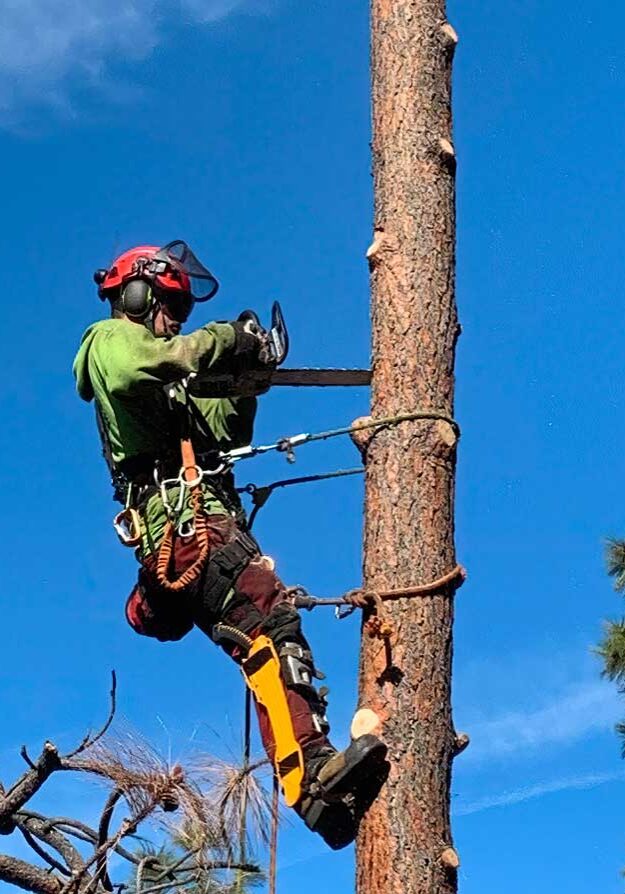
This is an area where experience shows quickly. A support system installed on a poorly pruned tree is often solving only half the problem. If the crown still carries excess leverage, if cuts have been made indiscriminately, or if a previous contractor topped the tree, the tree may continue to respond badly. Weak regrowth, unbalanced crown development, and recurring stress can all complicate the original issue.
That is why Tree Pruning & Crown Shaping should never be treated as cosmetic work alone. Good pruning supports the mechanical and biological reality of the tree. It redistributes weight, improves structure where possible, and works with the support plan rather than against it.
What an arborist looks for before recommending structural support
Before anyone talks seriously about cable and bracing, the first task is assessment. The quality of that assessment determines everything that follows. An ISA Certified Arborist is trained in the art and science of tree care, must pass a comprehensive exam, continue education, and follow a code of ethics. That matters because structural support decisions are not casual. They affect safety, costs, long-term management, and sometimes legal exposure if a tree later fails.
A responsible arborist will consider the tree itself and the site around it. The tree’s size, species, growth habit, visible defects, canopy form, and likely targets all influence the recommendation. A tree over a quiet back corner of a property is not evaluated in the same way as a tree leaning above a driveway, playground, storefront, or neighbor’s roof.
Here are some situations that commonly justify a closer look from a qualified professional:
- A major branch or stem appears to move excessively in wind.
- The canopy is heavily weighted to one side.
- A visible structural defect raises concern near a high-use area.
- A previously damaged tree remains important to the landscape.
- Storm exposure has increased concern about failure potential.
That list is not a diagnosis. It is simply a prompt to stop guessing. Many trees look dramatic but remain manageable. Others appear stable until an experienced eye points out the real issue.
The value of a Certified Arborist Consultation
There is a practical reason homeowners and property managers benefit from Certified Arborist Consultation before authorizing structural work. Tree care choices are interconnected. A support system may preserve a tree, but it can also commit the owner to future inspections and maintenance. Pruning may reduce stress, but too much reduction can compromise form and function. Removal may eliminate a hazard, but it also creates follow-up work such as Stump Removal & Grinding if the stump will interfere with use of the site.
A consultation helps clarify those trade-offs. In a straightforward case, the answer may be obvious. In a borderline case, the arborist’s role is to explain what risk can be reduced, what cannot be promised, and what maintenance the tree will likely need going forward.
That ethical clarity matters. Some tree owners are told what they want to hear. A weak tree is called “fine” because nobody wants to lose the job. A support system is installed where removal was the more defensible recommendation. Months later, the tree fails in a storm, and the owner wonders why no one warned them. Good arborists do warn clients, even when the message is unwelcome.
When emergency conditions change the equation
Support systems are usually discussed during planned maintenance, but not always. After storms, snow loads, or sudden branch failures, owners often need fast answers. That is where Emergency Tree Services become essential. Emergency response in arboriculture is not just about cleanup. It is about restoring safety, stabilizing the site, and deciding whether a damaged tree can remain.
Sometimes a storm-damaged tree may still be a candidate for pruning and structural support. Sometimes the damage reveals weaknesses that were already present but went unnoticed. And sometimes the damage is extensive enough that the tree no longer qualifies for preservation.
In emergency work, speed can pressure judgment, which is why training and standards matter so much. Emergency tree operations involve hazards, especially around large limbs, compromised stems, and partially failed canopies. Controlled lowering of material, proper rigging, and careful sequencing are part of professional practice for a reason. The job is to reduce immediate danger without creating a second incident during the work itself.
One of the more difficult situations occurs when a tree has not fully failed, but clearly has lost structural reliability. Homeowners often ask whether a quick brace or cable can “get it through the season.” That may or may not be realistic. A stopgap mindset is risky if the tree stands over a high-value target. Some emergency calls end with temporary stabilization measures and follow-up planning. Others end with Tree Removal Services the same day because the risk is already unacceptable.
Preservation has limits, and that is not a failure
People understandably admire preservation. Keeping a mature tree feels responsible, and often it is. But preservation should not become a reflex. There are cases where a support system can reduce risk enough to justify retention. There are also cases where support merely delays a necessary decision.
A tree can be biologically alive and still be structurally unsuitable for its location. That difference is hard for nonprofessionals to accept at first. If leaves are present and the canopy still looks green, owners assume the tree is basically sound. Structural defects do not always announce themselves with dramatic symptoms. Risk assessment exists precisely because appearance alone can be misleading.
The other limit is site use. A tree in a low-traffic naturalized area may be tolerated with a higher degree of residual risk than a similar tree beside a school entrance or over a parking area. Risk is not just about the tree defect. It is about the likelihood of failure and the consequences if failure occurs.
This is where Dangerous Tree Assessment and Removal becomes less about fear and more about context. The same defect can lead to different recommendations depending on the occupancy and exposure around the tree.
The aftercare owners often overlook
One of the least glamorous parts of Tree Cable and Bracing is what happens after installation or treatment. Property owners often think in terms of one visit and one invoice. Trees do not work that way. If a tree needed structural support in the first place, it deserves periodic review. Growth changes the loading pattern. Weather events test the structure. Pruning objectives evolve over time.
That does not mean every supported tree becomes an endless maintenance burden. It means the owner should expect a management relationship rather than a one-time Tree Pruning & Crown Shaping intervention. In many landscapes, that ongoing care is still far less disruptive than removal and replacement. In others, especially where a tree continues to raise concern year after year, removal may become the more practical path.
If removal does become necessary, the conversation usually expands. Owners ask whether the stump should remain, whether roots will affect future planting, and whether the area can be repurposed immediately. This is where Stump Removal & Grinding often becomes part of the overall project. It is not directly related to cable and bracing, but it frequently enters the picture when a preserved tree cannot ultimately be retained.
Fire risk and structural risk are not the same thing
In regions where wildfire planning matters, homeowners sometimes assume any tree-care decision should be filtered through fire mitigation first. There is some overlap, but structural support and wildfire readiness are different concerns. A tree that benefits from support may still require spacing, pruning, or broader property planning under FireSmart Tree Services. Conversely, a tree managed for fire resilience may still have structural defects that require separate evaluation.
The important point is that one service category should not stand in for another. Fire-oriented work addresses fuels, defensible space, and vegetation management priorities. Structural support addresses mechanical weakness and failure potential. On a well-managed property, those goals can complement each other, but they should not be confused.
I have seen owners become overly attached to a tree because it contributes shade and screening, then resist pruning because they fear losing visual cover. Later they ask for fire-related service and are surprised to hear that reduction of certain canopy features may still be recommended. Trees must be managed according to both their biological reality and their location. No single treatment solves every site objective.
How to talk with your arborist about options
A good consultation should leave you with a clearer picture, not just a sales proposal. If a tree is being considered for support, the owner should understand what problem is being addressed, what other measures are recommended, and what the limits of the treatment are. That conversation does not need to be technical to be useful, but it does need to be honest.
These are reasonable points to clarify during a site visit:
- What defect or weakness is driving the recommendation?
- Is pruning part of the risk reduction plan?
- What level of ongoing monitoring should be expected?
- Would removal be more defensible in this location?
- How would storm damage change the plan?
Questions like these help expose whether the recommendation is thoughtful or routine. If the answer to every problem is “cable it,” caution is warranted. The same is true if the answer to every problem is removal. Tree care is rarely that simple.
The best outcomes come from restraint and judgment
The most effective structural support work is rarely dramatic. It comes from measured decision-making, careful assessment, and a willingness to combine treatments when needed. Sometimes the right answer is support plus pruning. Sometimes it is monitoring after a Certified Arborist Consultation. Sometimes the tree must be removed because the risk cannot be reduced enough for the site.
That balance is what separates professional arboriculture from improvised tree work. The industry includes pruning, maintenance, removal, and storm-damage response for both residential and commercial properties, but not all jobs call for the same tool. Structural support sits in the middle ground between doing nothing and taking the tree down. Used well, it can preserve important trees and reduce risk in a meaningful way. Used indiscriminately, it can give owners false confidence.
For property owners, the practical lesson is straightforward. If a tree shows signs of structural weakness, or simply causes concern because of its size and location, do not rely on guesswork. Do not let aesthetics alone drive the decision. And do not assume that visible life in the canopy means the structure is sound.
The right response starts with informed evaluation. From there, the tree may remain with support, receive Tree Pruning & Crown Shaping, require Emergency Tree Services after sudden damage, or move into Tree Removal Services with Stump Removal & Grinding as the next step. Those are not competing ideas. They are parts of the same professional toolbox, used according to what the tree and the site actually require.
When structural support is appropriate, it can be a smart, disciplined way to retain trees that still deserve a place in the landscape. When it is not appropriate, saying so is just as important. That kind of restraint is what good arboriculture looks like.
Name: Ace Tree Services Ltd.
Address: 4656 Wallace Hill Road, Kelowna, BC
Phone: 250-212-9593
Website: https://acetree.ca/
Hours:
Monday: 7:00 AM–5:00 PM
Tuesday: 7:00 AM–5:00 PM
Wednesday: 7:00 AM–5:00 PM
Thursday: 7:00 AM–5:00 PM
Friday: 7:00 AM–5:00 PM
Saturday: 7:00 AM–5:00 PM
Sunday: Closed
Emergency tree services: 24/7 emergency service is listed.
Open-location code / Plus code: RHF8+8G Kelowna, British Columbia, Canada
Map/listing URL: https://www.google.com/maps/place/Ace+Tree+Services+Ltd./@49.8232606,-119.4337283,563m/data=!3m1!1e3!4m6!3m5!1s0x537d8b1d074815c5:0x450b88afa7a41435!8m2!3d49.8232606!4d-119.4337283!16s%2Fg%2F11ydkpnh22
Embed iframe:
Socials: https://www.facebook.com/people/Ace-Tree-Services/61585901931447/
https://m.yelp.com/biz/ace-tree-services-kelowna
Ace Tree Services Ltd. provides professional tree service for residential, commercial, and municipal customers in Kelowna and across the Okanagan Valley.
The company’s listed services include tree removal, stump removal and grinding, tree pruning and crown shaping, emergency tree services, certified arborist consultation, dangerous tree assessment, tree cable and bracing, and wildfire mitigation.
Ace Tree Services works with homeowners, businesses, property managers, and public-sector clients that need safe, practical tree care in the Kelowna area.
The official site highlights ISA-certified arborists, insurance, and experience handling both routine and complex tree service situations.
Customers can contact Ace Tree Services for tree care planning, hazard concerns, emergency tree cleanup, pruning needs, stump grinding, or advice about trees near homes, fences, driveways, and landscaping.
Ace Tree Services lists regular work hours from 7:00 AM to 5:00 PM Monday through Friday, with 24/7 emergency tree service available for urgent situations.
For tree service in Kelowna, call 250-212-9593 or visit https://acetree.ca/
The public map listing places Ace Tree Services Ltd. in Kelowna and can help customers find directions to the Wallace Hill Road area.
Popular Questions About Ace Tree Services Ltd.
What services does Ace Tree Services Ltd. provide?
Ace Tree Services Ltd. provides tree removal, stump removal and grinding, tree pruning and crown shaping, emergency tree services, certified arborist consultation, dangerous tree assessment and removal, tree cable and bracing, and wildfire mitigation.
Where is Ace Tree Services Ltd. located?
The official website lists Ace Tree Services Ltd. at 4656 Wallace Hill Road, Kelowna, BC.
What areas does Ace Tree Services Ltd. serve?
The official website describes Ace Tree Services as located in Kelowna and servicing the Okanagan.
What phone number should customers call?
Customers can call Ace Tree Services Ltd. at 250-212-9593.
What are Ace Tree Services Ltd.’s regular hours?
The official website lists work hours as 7:00 AM to 5:00 PM, Monday through Friday. Saturday and Sunday regular hours are not listed and should be confirmed directly.
Does Ace Tree Services Ltd. offer emergency tree service?
Yes. The official website lists 24/7 emergency services for urgent tree situations, including emergency tree removal, dangerous tree assessment, stabilization, and limb or branch cleanup.
Does Ace Tree Services Ltd. have certified arborists?
Yes. The official website states that Ace Tree Services has ISA-certified arborists.
Can Ace Tree Services Ltd. help with wildfire mitigation?
Yes. Wildfire mitigation is listed as one of the company’s tree services.
How do I contact Ace Tree Services Ltd.?
Call 250-212-9593 or visit https://acetree.ca/.
Landmarks Near Kelowna, BC
Wallace Hill Road: A local Kelowna road near the address listed for Ace Tree Services Ltd.
Okanagan Lake: A major Kelowna landmark near residential, commercial, and waterfront properties that may need tree pruning, removal, or hazard assessment.
Downtown Kelowna: A central area with homes, offices, rental properties, restaurants, and commercial sites that may need professional tree care.
Mission / Lower Mission: A well-known Kelowna area with mature landscaping, residential properties, and lake-adjacent homes.
South East Kelowna: A rural and residential area with larger properties, orchards, and tree-care needs that can include pruning, removals, and wildfire mitigation.
Crawford: A residential area near the southeast side of Kelowna where homeowners may need tree trimming, hazard assessment, and stump grinding.
Kettle Valley: A hillside residential neighborhood where tree condition, slope, wind exposure, and defensible-space planning can matter for property owners.
Myra-Bellevue Provincial Park: A major outdoor landmark near southeast Kelowna and a useful point of orientation for nearby properties.
Gallagher’s Canyon: A residential and golf community near southeast Kelowna where tree maintenance and wildfire-conscious vegetation management can be practical concerns.
Orchard Park Shopping Centre: A major central Kelowna retail landmark and reference point for customers traveling across the city.
Highway 97: A major Kelowna corridor connecting neighborhoods, commercial properties, and service routes throughout the region.
Kelowna City Park: A recognizable central landmark near downtown neighborhoods and lakefront properties.
Glenmore: A Kelowna neighborhood with residential and commercial properties that may need pruning, storm cleanup, and general tree care.
Rutland: A large residential and commercial area where customers may need tree removal, pruning, stump grinding, or arborist consultation.
Black Mountain: A hillside community where slope, wind, wildfire exposure, and access can influence tree service planning.
For tree service near these Kelowna landmarks, contact Ace Tree Services Ltd. at 250-212-9593 or visit https://acetree.ca/